What is an ATS score, and does it matter?
Published September 21, 2026
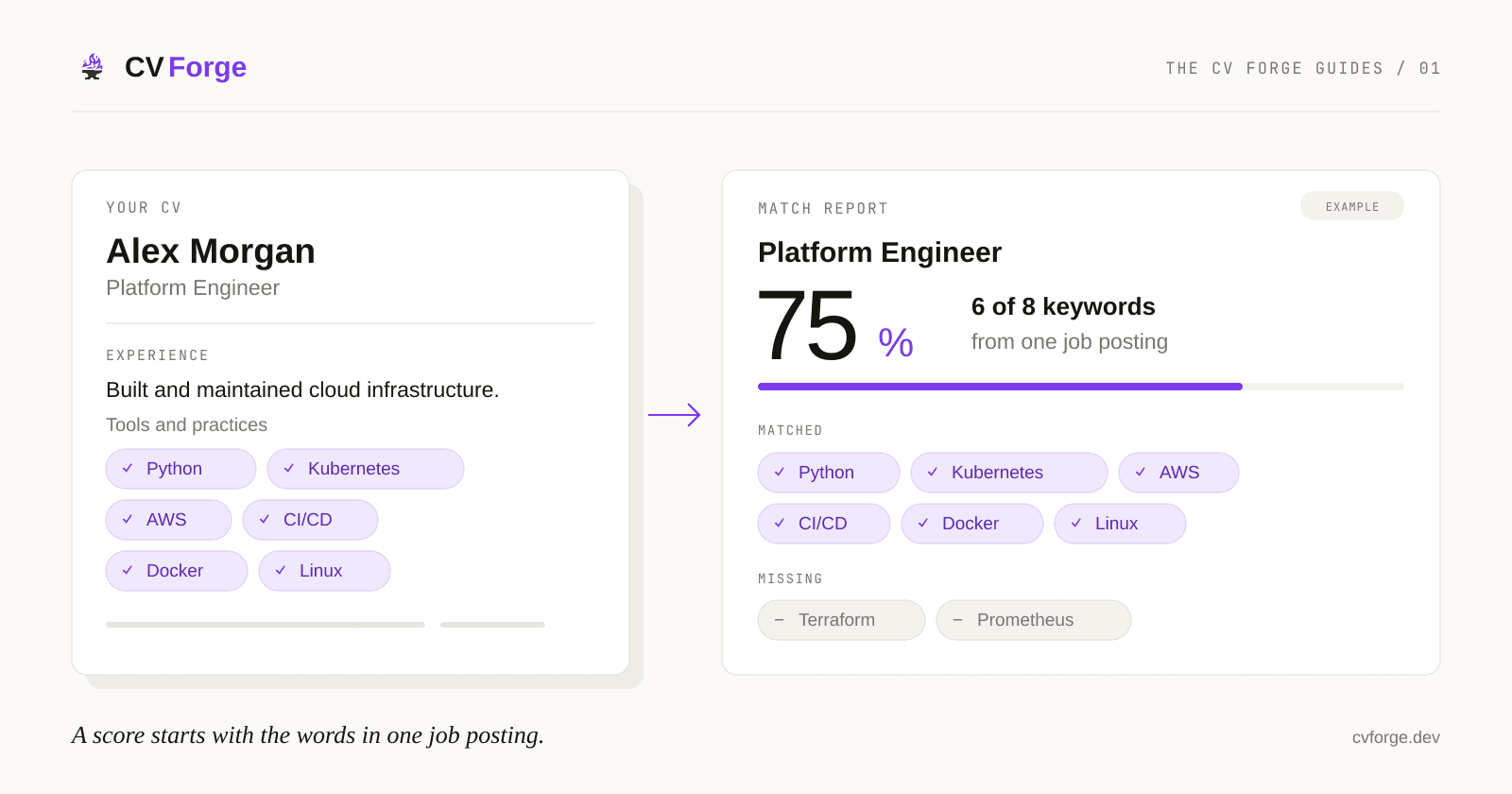
If you have applied for jobs online, you have probably been told your CV needs a good "ATS score" to get through. The advice is half right. Applicant tracking systems are real and they do shape who gets seen, but there is no single ATS score that every employer checks. This guide explains what happens to your CV after you click apply, what a score can and cannot tell you, and how to improve your chances for a specific role.
What is an ATS?
An applicant tracking system (ATS) is the software employers use to collect and manage applications. Workday, Greenhouse, Lever, SAP SuccessFactors and Teamtailor are common examples. When you apply through a careers page, your CV almost always lands in one of these.
The system does three things that matter to you:
- It parses your CV, pulling your name, job titles, dates, education and skills out of the file and into structured fields.
- It makes you searchable. Recruiters search and filter the candidate pool, usually by keywords, job titles, location or years of experience.
- It may ask knockout questions, such as "Do you have the right to work in this country?" A wrong answer can filter you out automatically.
Is there such a thing as an ATS score?
Not in the way the phrase suggests. There is no industry standard, and most systems do not reject CVs because a number fell below a line. Some systems rank or tag candidates by how well they match the posting, and every system lets recruiters search. In both cases, what counts is whether your CV contains the words the employer is looking for.
So when a tool shows you an "ATS score", read it as an estimate of how well your CV matches the language of this particular job posting. That is still worth knowing. A recruiter searching for "stakeholder management" will not find a CV that only says "worked with clients and internal teams".
A useful score also has to know which words in a posting are skills at all. "Platform" and "solutions" turn up in plenty of job ads without naming anything you could put on a CV. CV Forge has an AI model read the posting for the skills, tools, certificates and licences it asks for, in the posting's own words, and keeps only what the posting actually says. Two public skills databases, the EU's ESCO classification and the US O*NET database, plus terms we add ourselves, then recognise the different ways a CV may write the same thing, such as Postgres for PostgreSQL. You can see which keywords it finds in a posting with the free ATS checker.
How to raise your match for a specific job
-
Read the posting for its key terms
Look for skills, tools, certifications and job titles that come up more than once, or that appear in the requirements rather than the nice-to-haves.
-
Use the employer's wording where it is true
If you did the work, describe it with their term. "Customer success" and "account management" can mean the same job, but a search only finds the one you wrote.
-
Put keywords where they carry weight
A skills list helps, but a keyword inside a concrete achievement ("Cut onboarding time by 30% by rebuilding the Salesforce workflow") helps more, because the human who reads it next is convinced too.
-
Match the job title when it is honest
If your title was "Customer Hero" and the role is "Customer Support Specialist", put the standard title alongside yours.
-
Tailor each application
A CV that matches one posting well usually matches the next one less well. Most people skip this step, and it is where you gain the most.
Make sure the system can read your CV
A perfect keyword match does not help if the parser cannot read the file.
- Use a text based PDF or a Word document, not a scan or an image.
- Keep the layout simple: one column is safest, and important details should not sit in headers, footers, text boxes or tables.
- Use standard section headings such as Experience, Education and Skills.
- Write dates in a consistent format, for example "03/2021 to 08/2024".
What not to do
Do not paste the job description into your CV in white text, and do not list skills you do not have. Recruiters see the parsed text, and a CV that promises what the interview cannot deliver costs you more than a lower match would. A score of 100% is not the goal. If a keyword names something you have never done, leaving it out is the right call.
The short version
An ATS score measures how closely your CV follows the wording of one job posting. Nothing passes or fails on it, but that wording decides whether you show up when a recruiter searches. Match the wording where it is true, keep the layout readable, and tailor every application. You can try it on your own CV with CV Forge.